Strategic Ambiguity
Sub-Surface Strategy™ | Core Briefing
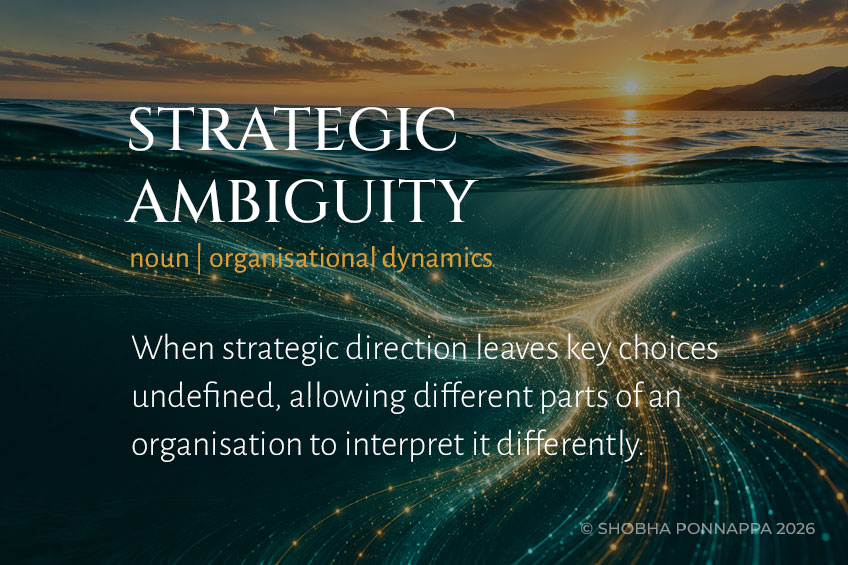
Every strategy contains choices that determine how an organisation will pursue its ambitions. Some are explicitly established by leadership, while others remain open because circumstances are uncertain, information is incomplete or their implications have not yet been fully considered. When those unanswered questions are left unrecognised, people throughout the organisation begin supplying their own answers. Leadership must take responsibility not only for the strategic choices it makes, but also for the gaps it leaves behind.
Strategic Ambiguity becomes consequential when local interpretations turn into organisational plans, resource commitments and expectations that were never collectively established. By the time these differences become visible, considerable effort may already have been invested in directions that leadership did not consciously choose. Preventing this requires more than communicating strategic ambitions clearly. Leaders must develop the discipline to recognise, examine and govern the unanswered questions that shape organisational decisions.
Action 1: Identify What The Strategy Leaves Unanswered
Leaders should examine their strategies for the important choices that remain unspecified. Broad ambitions such as growth, innovation, customer value and operational excellence may establish direction without clarifying what the organisation should prioritise in practice. These gaps create the conditions in which different interpretations begin to develop independently. Leadership must recognise the unanswered questions within a strategy before those questions acquire organisational consequences.
This requires looking beyond what the strategy explicitly states. Leaders should examine which markets, activities, investments, trade-offs and expectations have actually been decided, and which have simply been assumed. A strategy review should therefore consider not only the decisions recorded but also the decisions that people will inevitably need to make in order to act. What the strategy does not specify deserves as much leadership attention as what it formally declares.
Action 2: Distinguish Flexibility From Unresolved Choices
Leaders should distinguish between decisions deliberately left to local judgement and decisions that have not yet been made. Organisations need flexibility because circumstances differ across functions and people closest to the work often possess information unavailable at the centre. However, flexibility without understood boundaries can leave people deciding matters that leadership intended to retain or had simply overlooked. Delegated judgement and unresolved strategic choices must never be mistaken for the same thing.
This distinction should be made explicit whenever strategic direction is translated into organisational expectations. Leaders need to establish which decisions departments may make independently, which require consultation and which remain matters for executive determination. Doing so preserves legitimate local autonomy without requiring people to invent the strategic boundaries within which they are expected to operate. People should have freedom to make decisions within an established strategic framework, not the responsibility to create that framework themselves.
Action 3: Surface The Assumptions Behind Decisions
Leaders should examine the assumptions supporting important departmental plans and proposals. A proposal may appear entirely consistent with the strategy while depending upon an interpretation that nobody has explicitly discussed. These assumptions often remain invisible because the people making the decisions regard them as obvious consequences of the agreed direction. Strategic Ambiguity becomes difficult to recognise when assumptions are presented as though they were established decisions.
Leadership conversations should therefore explore why particular priorities have been selected and what strategic expectations those choices depend upon. When different functions explain their decisions, the underlying assumptions can be compared before they become embedded in substantial commitments. This does not require challenging every local judgement, but it does require distinguishing an authorised choice from an interpretation supplied in its absence. An assumption should become visible and open to examination before it becomes the foundation of organisational action.
Action 4: Establish Ownership Of Unanswered Questions
Leaders should ensure that important strategic questions have clear ownership. When a choice remains unresolved, it should not disappear into the general understanding that departments will work it out as they proceed. Without ownership, different functions may independently reach conclusions that become increasingly difficult to reconcile. Every consequential strategic question needs an identifiable owner, even when its final answer is not yet available.
This does not mean that every decision must be made by the chief executive or executive team. Responsibility may appropriately sit with a functional leader, a cross-functional group or an individual with the relevant authority and information. What matters is that the organisation knows who is responsible for resolving the question, what authority they possess and when a decision is expected. An unanswered question should remain a recognised leadership responsibility rather than become an invisible departmental assumption.
Action 5: Examine The Organisational Implications Together
Leaders should examine how different interpretations of strategic direction interact across the organisation. A decision that appears appropriate within one department may create demands, costs or constraints elsewhere that were never considered when the decision was made. Reviewing departmental plans independently can therefore conceal the cumulative implications of assumptions that have developed separately. Strategic choices must be examined in the context of the organisation they collectively shape.
This requires bringing the relevant functions into conversations about the practical consequences of important strategic ambitions. Leaders should explore how proposed priorities affect resources, capabilities, investments and expectations elsewhere in the business. The purpose is not to eliminate every difference in departmental judgement, but to establish whether the resulting commitments can be supported within the same strategic direction. A decision is not strategically sound simply because it makes sense within the department that proposes it.
Action 6: Govern Commitments Built On Assumptions
Leaders should pay particular attention to organisational commitments that depend upon unresolved strategic questions. Budgets, recruitment, investments, supplier arrangements and operational plans can all become difficult to reverse once resources have been committed. If these decisions rest on assumptions that leadership has never examined, the organisation may gradually become committed to directions it never deliberately selected. Strategic assumptions must not acquire the authority of established organisational commitments without examination.
Where decisions cannot wait for complete certainty, leaders should make the provisional nature of those decisions explicit. They should establish the assumptions on which approval depends, the limits of the commitment and the circumstances under which it must be reconsidered. This allows work to continue without pretending that every strategic question has already been settled. Provisional decisions should remain recognisably provisional until their underlying strategic questions have been resolved.
Action 7: Protect Strategic Flexibility
Leaders should recognise strategic flexibility as an organisational resource that can be consumed by accumulated commitments. When different departments have built plans around their own interpretations, changing direction becomes increasingly difficult because resources, expectations and capabilities are already committed. The organisation may retain formal authority to change its strategy while losing much of its practical freedom to do so. The cost of Strategic Ambiguity is not only what organisations commit, but also the choices they gradually lose the freedom to make.
This makes the examination of existing commitments an important leadership discipline. Leaders should periodically consider which resources are tied to decisions based on assumptions that have not been collectively established and what capacity remains available for alternative opportunities. The objective is not to prevent commitment, but to ensure that commitments reflect choices the organisation actually intends to make. Protecting strategic flexibility means preventing unexamined assumptions from determining the organisation’s future options.
Action 8: Institutionalise Strategic Specification
Leaders should make the examination of strategic gaps a permanent part of their strategic governance. Strategic planning should not end when ambitions and priorities have been agreed, because their practical implications may still contain unanswered questions. Every significant strategic commitment should be examined for the choices, expectations and boundaries that people will need to understand before acting. Strategic specification must become an ongoing leadership discipline rather than an occasional exercise in clarifying direction.
This responsibility should extend through strategy reviews, investment decisions, resource allocation and significant changes in organisational priorities. As circumstances evolve, leaders should distinguish between questions that have been resolved, those that remain deliberately open and those that now require fresh consideration. The organisation should never have to discover through accumulated commitments that different parts of the business have been answering the same strategic question in different ways. The strongest strategic leadership ensures that organisational decisions are shaped by choices the organisation has consciously made, not by assumptions it has inadvertently accumulated.

The Question Beneath the Surface
What might be happening beneath the visible pattern that is shaping what people understand, decide and do?
Organisations often respond to what they can see: inconsistent decisions, competing interpretations, unexpected resource commitments or departments pursuing different versions of the same ambition. But visible patterns may originate in strategic choices that were never fully specified. The more revealing question is not simply why people are interpreting the strategy differently, but what the strategy has left open for them to interpret.
Explore This Concept Further
Continue exploring Strategic Ambiguity through its companion publications in the Sub-Surface Strategy™ Knowledge Library.
Each explores the same Canonical Concept from a different perspective while remaining within the same Knowledge Set.
Applying Sub-Surface Strategy™
Sub-Surface Strategy™ is both a discipline for understanding organisations and a practice for helping leaders navigate the invisible dynamics that shape organisational performance.
I work with organisations facing persistent strategic and organisational challenges that conventional approaches struggle to resolve. Together, we diagnose the invisible dynamics beneath those challenges and restore the conditions for clearer strategic thinking, stronger organisational coherence and more consistent execution.