Strategic Ambiguity
Sub-Surface Strategy™ | Discovery Essay
A strategy can appear perfectly clear in its overall direction while leaving important questions unanswered. Leaders may establish where the organisation needs to go, what it hopes to achieve and which broad priorities deserve attention. Yet the choices that determine how those intentions should translate into everyday decisions are not always made explicit. The organisation receives a direction, but not necessarily a complete understanding of what that direction requires.
This creates an unusual organisational situation. Different teams may believe they understand the strategy, even when they are making very different assumptions about what it means for their responsibilities. Each fills the unanswered spaces using its own judgement, experience and interpretation of what matters most. What appears to be one shared strategy can quietly become several different understandings of what the organisation is trying to achieve.
When Strategy Leaves Questions Unanswered
Strategic direction is often expressed through broad statements about growth, innovation, customer experience, operational excellence or market leadership. These statements establish an ambition, but they do not necessarily explain the choices that must be made to pursue it. Which customers deserve priority, what trade-offs are acceptable, and which activities should receive fewer resources may remain unresolved. A strategic direction can be clear about its destination while remaining unclear about the decisions required to reach it.
This is not necessarily a failure of strategic thinking. Leaders may deliberately retain flexibility because circumstances are changing, information is incomplete or decisions depend upon developments that have yet to occur. However, the organisation still has to make decisions while those questions remain open. People cannot suspend everyday responsibilities until every strategic implication has been settled. Unanswered strategic questions become practical organisational questions the moment somebody has to act.
What Happens In The Space Between Intent And Action
When a strategic choice has not been made explicitly, the people responsible for acting on the strategy must find a way forward. They draw upon their knowledge of the business, their understanding of local circumstances and their experience of what has worked previously. A commercial team may interpret growth as winning larger customers, while operations may understand it as increasing throughput and finance may favour protecting margins. Each interpretation can be entirely reasonable within the responsibilities of that particular function. The absence of an explicit strategic choice creates space for local judgement to become the basis of organisational action.
These interpretations do not necessarily arise from disagreement or resistance. People are often making the best decisions they can with the direction and information available to them. In the absence of a shared answer, they supply one themselves, usually without recognising that another part of the organisation may have supplied a different answer. The resulting differences can remain invisible because everyone believes they are acting in accordance with the same strategy. People can follow the same strategic instruction while responding to questions that the strategy never actually answered.
Why Different Interpretations Seem Equally Reasonable
The difficulty becomes clearer when we recognise that strategic gaps are rarely interpreted in isolation. Each function encounters the unanswered question through its own operational responsibilities, performance expectations and immediate pressures. A decision that makes perfect sense to a sales director may appear commercially irresponsible to a finance director, even though both are responding to the same strategic ambition. Neither necessarily has access to a complete picture of what the organisation intends the ambition to require. Local knowledge gives each interpretation its own logic, even when those interpretations have never been reconciled into a common direction.
This is why simply repeating the original strategic statement rarely resolves the situation. The words may be perfectly familiar to everyone, but familiarity does not supply the choices that were never specified. People continue applying their own assumptions because those assumptions are what allow them to make decisions and keep work moving. The organisation may therefore display considerable confidence in its strategy while operating through several different understandings of its practical requirements. Agreement about the stated ambition does not establish agreement about the choices needed to pursue it.
How Assumptions Begin To Shape The Organisation
Once people have supplied their own answers to unanswered strategic questions, those answers begin influencing everyday organisational decisions. Teams develop plans, allocate resources, establish measures and create working practices based on what they believe the strategy requires. Over time, these choices become embedded in ordinary routines and expectations. What began as an individual interpretation can gradually become an accepted way of working within a particular part of the business. An assumption can acquire the practical authority of a strategic decision without ever having been formally chosen.
The more established these assumptions become, the less likely people are to question their origins. New employees inherit existing practices, managers explain established priorities and performance measures reinforce the decisions already being made. Nobody needs to announce a different strategy for the organisation to begin operating according to different interpretations of its original direction. Each part of the business simply continues acting on the answers it has found for itself. The organisation can accumulate strategic commitments that were never explicitly made by its leadership.
The Organisational Cost Of Unspecified Choices
The consequences become visible when decisions made in different parts of the organisation begin interacting. One function may commit resources to an initiative that another has not considered strategically important, while a third makes plans based on entirely different expectations. Projects may proceed successfully within individual departments but fail to produce the combined outcome leadership intended. The difficulty is not necessarily that people are making poor decisions, but that they are making decisions from different assumptions about what the strategy requires. The organisation begins paying for strategic questions that were never answered at the point when they mattered most.
This can create a particularly difficult problem for leadership. When results fall short, attention often turns towards execution, accountability or the quality of individual decisions. Yet the people involved may have acted competently and consistently within the interpretations they had developed. Asking them to execute the strategy more effectively does not resolve the uncertainty that shaped their decisions in the first place. An organisation cannot reliably execute a strategic choice that it has never collectively understood or explicitly made.
Giving The Invisible A Name
There is a difference between a strategy that contains difficult choices and one that leaves those choices undefined. Difficult choices may require careful consideration, negotiation and deliberate trade-offs before leadership reaches a decision. Unspecified choices, by contrast, remain open even as the organisation proceeds as though their implications are understood. The distinction matters because the organisation may already be acting on answers that nobody at the centre has consciously selected. The absence of a strategic decision does not prevent the organisation from making one through its everyday actions.
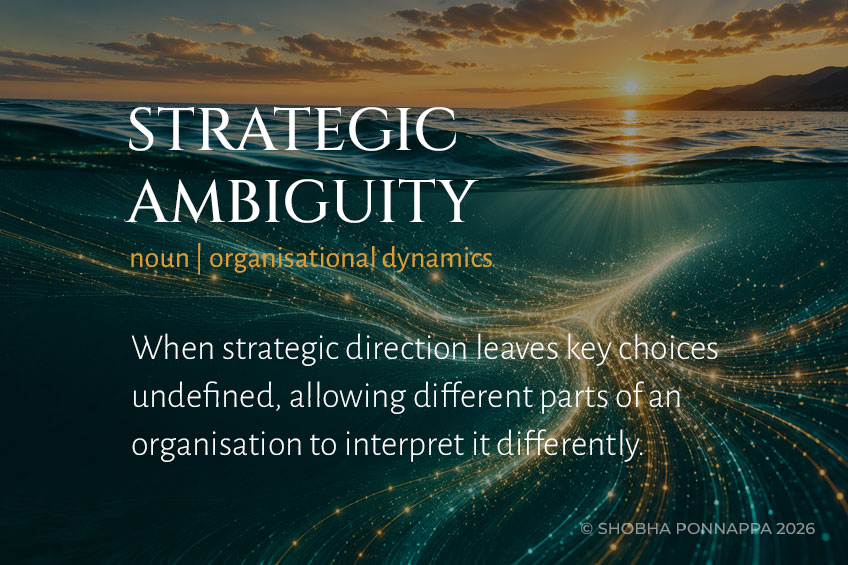
I call this phenomenon Strategic Ambiguity: the condition in which strategic direction leaves key choices or expectations undefined, allowing different parts of an organisation to interpret what it requires. It is not necessarily created by conflicting priorities, nor does it depend upon strategic meaning changing as it travels through the organisation. Its defining feature is the space left by what the strategy does not specify, and the different answers people supply to fill that space. Strategic Ambiguity exists when an organisation is acting on interpretations of strategic requirements that its strategy has never fully established.
Why Strategic Ambiguity Changes Leadership
Recognising Strategic Ambiguity changes the questions leaders ask about organisational performance. Instead of assuming that people have misunderstood the strategy or failed to follow instructions, leaders begin examining which important choices were never made explicit. They become more attentive to the assumptions underlying departmental plans, resource decisions and expectations of performance. The enquiry moves beyond whether the strategy was communicated to whether its practical requirements were ever sufficiently defined. Leadership must examine not only what the organisation has decided, but also what it has left for others to decide on its behalf.
This does not mean that every strategic question must be settled at the centre or that flexibility should disappear from organisational life. Some decisions properly belong to the people closest to the work, and some uncertainties cannot be resolved in advance. The important distinction is between choices that leadership has deliberately delegated and choices that remain unanswered without anyone recognising the consequences. Strategic freedom is meaningful when people understand the boundaries within which they are expected to exercise it. The freedom to make local decisions should not require people to invent the strategic direction those decisions are supposed to serve.
What A Strategy Must Ultimately Make Clear
No strategy can anticipate every situation an organisation will encounter. Circumstances change, new information emerges and people must exercise judgement in ways that cannot be prescribed in advance. Yet this does not remove the need to establish the choices, expectations and boundaries that give strategic direction its practical meaning. The organisation needs to know which questions have been answered, which remain deliberately open and where local judgement is expected to begin. Strategic clarity is not the elimination of uncertainty, but the recognition of what has been decided and what has not.
Perhaps the more revealing question for leaders is not simply whether everyone understands the strategy. It is whether everyone is making decisions from the same set of strategic choices, or whether different parts of the organisation have quietly supplied their own answers to questions leadership left unresolved. A strategy document may describe the intended direction in considerable detail, yet still leave important decisions to be made elsewhere. Those decisions will be made whether leadership acknowledges the gaps or not. The strategy an organisation actually follows may be shaped as much by the questions it leaves unanswered as by the decisions it formally declares.

The Question Beneath the Surface
What might be happening beneath the visible pattern that is shaping what people understand, decide and do?
Organisations often respond to what they can see: inconsistent decisions, competing interpretations, unexpected resource commitments or departments pursuing different versions of the same ambition. But visible patterns may originate in strategic choices that were never fully specified. The more revealing question is not simply why people are interpreting the strategy differently, but what the strategy has left open for them to interpret.
Explore This Concept Further
Continue exploring Strategic Ambiguity through its companion publications in the Sub-Surface Strategy™ Knowledge Library.
Each explores the same Canonical Concept from a different perspective while remaining within the same Knowledge Set.
Applying Sub-Surface Strategy™
Sub-Surface Strategy™ is both a discipline for understanding organisations and a practice for helping leaders navigate the invisible dynamics that shape organisational performance.
I work with organisations facing persistent strategic and organisational challenges that conventional approaches struggle to resolve. Together, we diagnose the invisible dynamics beneath those challenges and restore the conditions for clearer strategic thinking, stronger organisational coherence and more consistent execution.